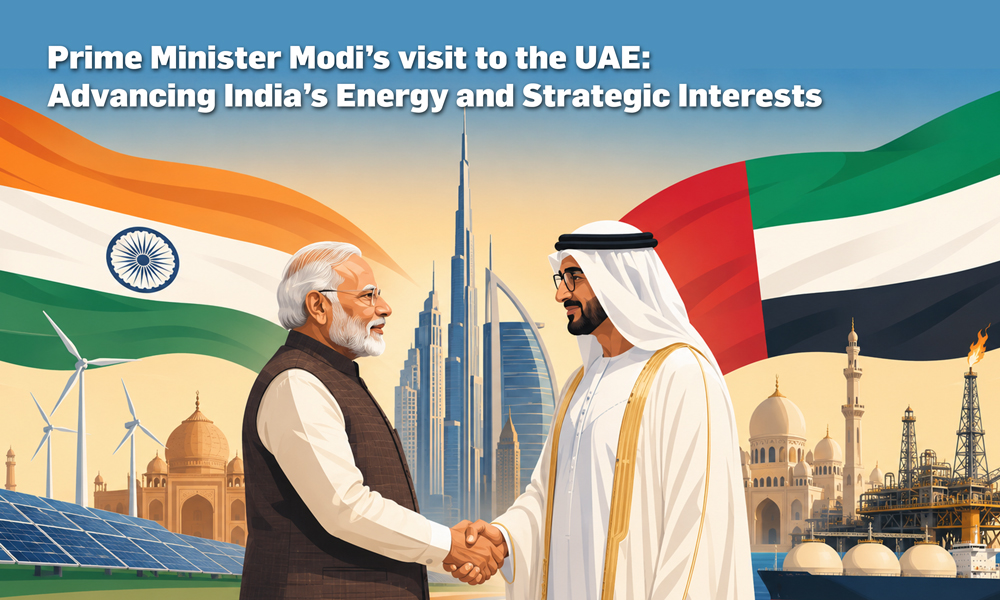
Prime Minister Modi’s visit to the UAE: Advancing India’s Energy and Strategic Interests
By Dr. Afroz Khan
Prime Minister Narendra
Modi visited the United Arab Emirates (UAE) on 15 May 2026, the first stop on
his five-nation tour. This was Prime Minister’s eighth visit to the UAE since
2014 and his first since the outbreak of the US-Iran conflict. During the
visit, Prime Minister Modi met UAE President Sheikh Mohamed bin Zayed Al
Nahyan, whom he has often referred to as a “brother and friend.†President Al
Nahyan is regarded as one of Modi’s closest international partners, and their
strong personal rapport has helped elevate India-UAE ties to a comprehensive
strategic and economic partnership. The UAE is India’s third-largest trading
partner, while India ranks as the UAE’s second-largest trading partner after
China. The visit comes at a time when West Asia is experiencing one of the most
volatile periods in decades. The US-Iran conflict and uncertainty surrounding
the Strait of Hormuz have shaken global energy markets. India, which is heavily
dependent on the region for its energy needs, has been severely affected by the
conflict.
India is the world’s
third-largest importer of crude oil, with 45% of its imports sourced from West
Asia. It is also the fourth-largest importer of liquefied natural gas (LNG),
with around 60% of imports coming from the region. Additionally, India is the second-largest consumer of
liquefied petroleum gas (LPG), with nearly 90% of its supply
coming from the same region. The UAE is India’s fifth-largest fuel import
source, accounting for about 6 per cent of total national crude imports, and
the third-largest source of LPG and petroleum products. UAE accounts for a
tenth of India’s overall oil imports. Much of this supply has been severely
affected by disruptions around the Strait of Hormuz. The unprecedented surge in
the energy market in over the past few decades has caused major challenges for
India, putting pressure on the current
account deficit (CAD) and exchange rate. The impact is most visible in
the Indian currency, which has hit record lows against the US dollar over the
past year. Furthermore, disruptions in fertilizer
supplies have also posed a significant threat to food security across the globe,
including in India, which is the world’s second largest consumer of fertiliser after China.
Why is this visit
significant?
When the conflict
started in the region, India initially adopted a policy of “wait and watch†due to the uncertainty surrounding the
rapidly unfolding events. However, the Iranian attacks on the Gulf Arab states heightened
India’s concern and directly threatened its interests because of the damage to
the critical infrastructure and loss of Indian lives.
Prime Minister Narendra
Modi’s visit to the UAE was largely shaped by these considerations. The visit
aimed to secure India’s long-term energy supplies, diversify its energy mix,
strengthen strategic reserves, and deepen partnerships to safeguard against
future energy volatility. During the visit, Modi reiterated India’s commitment
to a peaceful region and said India was ready to contribute and extend all
possible support to restore peace.
During this visit, India
and the UAE signed key agreements on strategic defence
cooperation, petroleum reserves and LPG supplies. The strategic defence partnership enables deeper
collaboration in defence manufacturing, innovation and advanced technology,
training and joint exercises, maritime security, cyber defence, secure
communications, and information sharing. Prime Minister Modi also reaffirmed
India’s strong support for the UAE during talks with President Al Nahyan,
stressing that New Delhi stands “shoulder-to-shoulder†with Abu Dhabi amid
growing regional instability in West Asia. Both leaders acknowledged the
success of the India–UAE Comprehensive Economic Partnership Agreement (CEPA),
which has significantly strengthened bilateral trade.
A landmark Strategic
Collaboration Agreement was also signed between the Indian Strategic Petroleum
Reserves Limited (ISPRL) and the Abu Dhabi National Oil Company (ADNOC),
establishing a comprehensive framework for strategic petroleum reserves (SPR) and liquefied natural
gas (LNG) cooperation. This agreement outlines a sophisticated, two-way energy
partnership designed to bolster the energy security of both the countries
through a distributed reserve architecture. Under this arrangement, ADNOC plans to expand
its physical presence in India by storing up to 30 million barrels of crude oil across
Indian facilities. Although the UAE will retain commercial ownership of the oil
for market sale, India will secure crucial “first rights†to access the crude
during supply disruptions or emergencies. Simultaneously, the agreement
explores storing Indian strategic crude reserve offshore at the UAE’s Fujairah
facility. Located on the eastern coast of the UAE along the Gulf of Oman,
Fujairah bypasses the volatile Strait of Hormuz entirely, thereby reducing the
impact of future geopolitical disruptions on India’s energy supplies and supply
chains. ADNOC also said it would explore expanded LPG supply and trading
opportunities with Indian Oil Corp.
The two countries also
agreed to invest $5 billion in India. This includes
a $3 billion investment by Emirates NBD in RBL Bank, a $1 billion investment by
Abu Dhabi Investment Authority (ADIA) with the National Infrastructure and
Investment Fund (NIIF) in priority infrastructure projects in India, and a
further $1 billion investment by International Holding Company (IHC) in Sammaan
Investment.
Conclusion
Prime Minister Modi’s
visit to the UAE underscores a critical pivot in India’s foreign policy amid
volatile conflicts in West Asia. The US-Iran friction has not only disrupted
global energy supplies but has also exposed deep regional fault lines, making
the power struggle between Saudi Arabia and the UAE more visible. Furthermore,
Saudi Arabia recently signed a Strategic Mutual Defence Agreement (SMDA) with
Pakistan, with the potential addition of Türkiye and Qatar.
India cannot afford to remain
aloof from these significant strategic alignments. To protect its interests,
New Delhi must proactively engage with all regional players. The UAE, alongside
Israel, is one of the strongest and most stable pillars of India’s regional
outreach, and active engagement secures India’s strategic and economic interests.
However, this does not mean India should rely entirely on these friendly
nations. Instead, as an emerging economic power, it must safeguard and prioritise
its own interests without getting entangled in regional tussles. India should
engage all parties through bilateral and multilateral forums while remaining
strictly non-partisan. India’s recent diplomatic manoeuvres, including National
Security Adviser Ajit Doval’s high-level talks in
Saudi Arabia and Petroleum Minister Hardeep Singh Puri’s strategic visit to
Qatar, indicate that this multi-aligned outreach is already well underway.
(Dr Afroz Khan holds a
PhD degree in West Asia from Jamia Millia Islamia University, New Delhi.
Earlier he was a Researcher at the Manohar Parrikar Institute for Defence
Studies and Analyses)
****