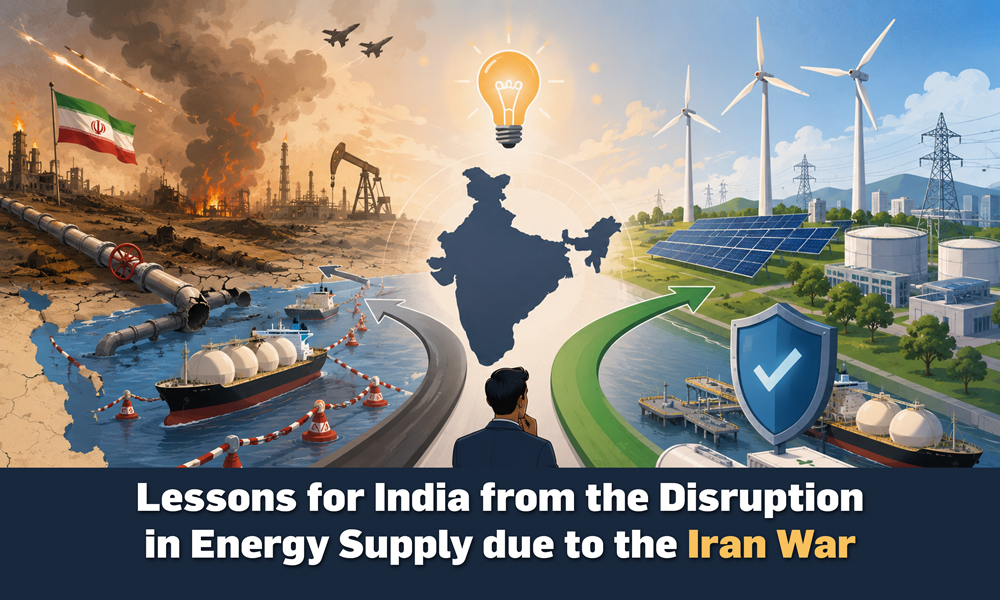
Lessons for India from the Disruption in Energy Supply due to the Iran War
Nazir Ahmad Mir
In the financial year 2026-27, India’s
economy was seen as a promising one that would show consistent and fastest
growth in the next financial year. Calling it the growth engine of South Asia,
the World Bank said that India’s economy was the fastest growing in emerging markets.
Speaking on the Economic Survey 2025-26, Chief Economic Advisor V.A. Anantha
Nageswaran had said in January that “India has potential to reach a 7.5%
growth
rate on account of improved manufacturing and land reforms.â€
No sooner was this positive projection of
India’s growth being presented than it was punctured by the United
States-Israel aggression against Iran on 28 February. As the World Bank report
came after the war on Iran, it underscored that due to the impact of the war and
closure of Strait of Hormuz, which would impact on India’s supply chain, the
economy would likely grow by 6.6% in 2026-27, a decrease by .4%. The impact of
a possible prolonged war can be detrimental to India’s economic growth.
The upshot is that India’s growth rate and
prosperity are dependent on imported energy. India in the past used to import a
lion’s share of its oil from Russia, Iraq, Saudi Arabia and the United Arab
Emirates (UAE); all these options are impacted by the ongoing Russia-Ukraine
war and the now the war in Iran. As the peace deal appears distant, the impact
on global economy is likely to be severe.
Iran war and closure of the Strait of
Hormuz
Whatever may have been the reasons for the
US-Israel war on Iran, its first direct impact has been disruption in the
global energy supply chain. It is a matter of fact that Iran had been warning
that if attacked by the US and Israel, it would close the Strait of Hormuz, the waterways between
the Persian Gulf and the Gulf of Oman through which over 20% of global seaborne
oil trade and significant volumes of liquefied natural gas and fertilisers take
place. Most of the energy supply via the strait goes to the Asian economies; about 80% oil imports pass through
the Strait of Hormuz. Likewise, the Asian countries import a significant percentage of
Liquefied Petroleum Gas (LPG), Liquefied Natural Gas (LNG) and fertilisers via
the strait. Iran has made it clear that unless US removes blockade that it has
imposed on Iranian ports. Few of Indian ships carrying oil has come under
attack.
India is heavily dependent on energy
imports for its growth, mainly in the manufacturing sector and domestic
consumption. It is the third-largest consumer of energy, after the US and
China. India imports 90% of LPG via the
Strait of Hormuz to meet 60% of its LPG
consumption. Furthermore, India imported 55-60% of the LNG supplies and over
40% of crude oil through the strait. Recently, Rs 37,500 crore coal
gasification mission to strengthen India’s energy security has been approved,
while the government has emphasised people to reduce consumption of fuel
through online office and schools and not making unnecessary travel.
The closure of the Strait of Hormuz has
disrupted India’s energy supply chain, hitting the consumers as the government
is forcing the country to take measures to address the challenge. The prices of
LPG cylinders have already been
increased. As mentioned, not only is the growth rate going to be adversely
impacted, but also meeting domestic demand and controlling inflation are going
to be issues in the coming days, if the war is prolonged. With no clear signs
when the war is going to end and the supply chain restored, uncertainty will
impact the growth and inflation across the world, including India. When the war against
Iran started to expand and last longer, India, for example, had to divert fuel
from the manufacturing sector to meet the household demands. This will directly
have an impact on exports, and thus on the country’s current account. Prime
Minister Modi, speaking in the Parliament, said India has expanded its energy
import sources from 27 countries to 41 countries over the past 11 years,
thereby reducing dependence on any single region.
Adapting to Energy Crisis: India’s Options
There is a possibility that energy supply
crises may keep recurring, impacting the global supply chain. Geopolitical
conflicts, trade wars and attempts by oil-producing countries to control prices
can disrupt energy supply chains from time to time. While deciding to launch
the war against Iran, the US paid least attention to the
possible economic fallout of its decision on the
countries that depended on the region for energy supplies.
The war is affecting India’s energy supply
chain and forcing the country to take measures like directing fuel from the industry sector to meet household demands, and to keep its impact on distribution
and pricing of domestic LPG minimal. The government said in March, “We are
committed to safeguarding our citizens from the impact of the conflict". Also, 13% of India’s total exports go to West Asia, and India received 38% of its total remittances
from the region. Both have been affected by the war in the region.
Even within the US, voices are being
raised about the war’s recklessness and the economic fallout. Now the priority
has shifted from changing Iran’s behaviour and the government in the country to
opening the Strait of Hormuz to restore the global energy supply chain. Not to
mention that the likely impact of the strait's closure is uneven, with the US
economy so far less impacted. The impact of the war on the US economy will shape
Washington’s policy towards Iran. It is not concerned about the global impact of
this crisis but it may be about its own.
For India, the impact has been double. In
February, the US had asked New Delhi to phase out its oil imports from Russia which
has been the cheapest source of import. Given India’s demands and its
availability at a lower price, its oil imports from Russia had peaked in Fiscal
Year 2025 with 38%, a manifold increase from 2% in 2021. Consequently, India’s
oil imports from Russia fell to 20% in February. However, the US
waived the restriction to allow countries to buy Russian oil from already
loaded Russian tankers that were at sea to cushion the energy shortage that
would have a spiralling effect on the global economy. This waiver was
applicable till 16th of May. According to media reports in
May, India was importing at a record 2.3 million barrels a day of Russian oil, which may
drop to 1.9 million barrels if no Russian oil is headed towards India. Though Moscow is eager
to supply LNG and fertiliser to India, due to the US sanctions, Indian
companies are not interested in striking a deal.
Even now, there are no clear signs whether
the Iran war is going to end. And if yes, when? To deal with the crisis, it is
important to come up with measures, like fuel saving, to manage the immediate
shortage of oil and other energy sources.
Uncertainty in the energy supply chains
not only leads to disruptions, like the ongoing shortage in oil and LPG
supplies, but also impairs confidence in the long-term sustainability of
economic growth. Sustainable growth and economy remain preferable and give more
confidence to investors than growth bursts that are short-lived.
In the long term, to immunise the economy
to external disruptions and uncertainty in global politics that affect the
energy supply chain, India needs to work on measures that would help in
reducing dependency on energy imports. A more viable and sustainable option is
to invest in renewable energy, like solar energy and wind energy. Both these
sources are abundant in nature and sustainable. India ranks third globally in
Renewable Energy Installed Capacity India and has achieved a total non-fossil
capacity addition of 55.3 GW during FY 2025–26. Utilising these
sources may make India resilient to future shocks. Also, overreliance on import of critical minerals
like lithium, cobalt, and nickel may be subject to supply chain disruption. In
an era when weaponising trade is becoming a hallmark of international politics,
India needs to be careful while exploring new options.
A better shield, therefore, will be a mix
of various available options, rather than a complete switch to solar or wind
energy, for example: using each possible option to the optimum, with the least
dependence on their imports. That is utilising the domestic energy resources
efficiently while not overusing them when there is availability of external
sources. And whenever there is a disruption in the external energy supply
chain, utilise diverse domestic sources efficiently in a more sustainable way
by deploying measures to save fuel.